
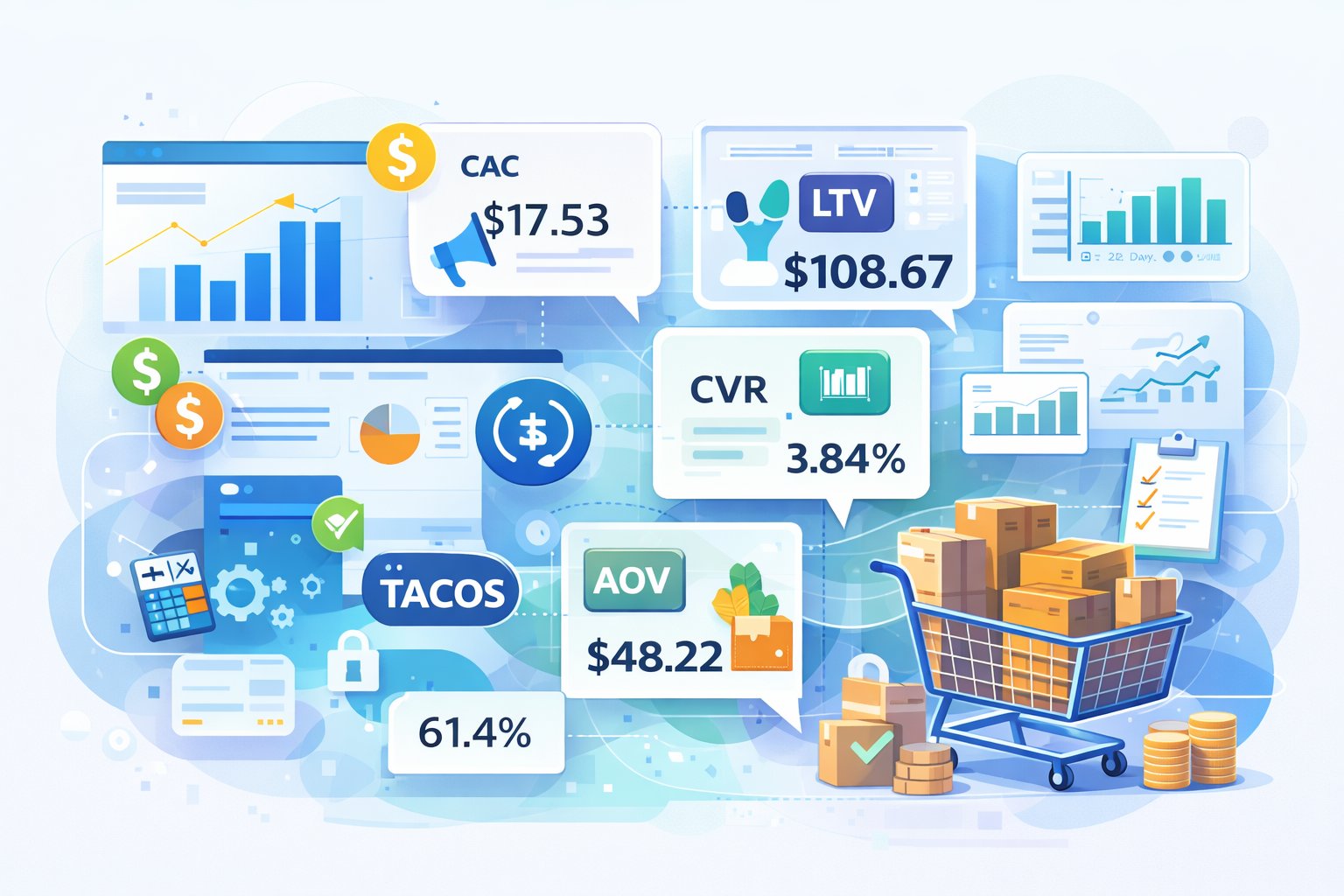
Tracking eCommerce KPIs is essential for understanding how an online business performs. While revenue measures sales, other indicators reveal profitability, customer satisfaction, and operational efficiency.
Successful brands use eCommerce KPIs to identify opportunities, reduce unnecessary costs, and improve business decisions.
Here are seven important metrics every online retailer should monitor.
Key Takeaways
- Revenue alone doesn’t show how healthy an online business is.
- Seven KPIs give a fuller picture: conversion rate, customer acquisition cost, average order value, profit margin, customer lifetime value, ROAS and inventory turnover.
- Compare acquisition cost with lifetime value to judge whether growth is sustainable.
- Pick the KPIs that match your goals and review them consistently.
1. Conversion Rate
Conversion rate measures how many website visitors complete a purchase.
A higher conversion rate often indicates that your product pages, pricing, and checkout experience meet customer expectations.
To improve results, optimize product descriptions, simplify navigation, and provide clear product images.
2. Customer Acquisition Cost
Customer acquisition cost (CAC) measures how much money a business spends to attract a new customer.
For example, spending $1,000 to acquire 50 customers results in a CAC of $20.
Therefore, tracking acquisition costs helps businesses evaluate marketing efficiency and control expenses.
3. Average Order Value
Average order value (AOV) represents the average amount customers spend per transaction.
Businesses can increase AOV through product bundles, personalized recommendations, and relevant cross-selling opportunities.
As a result, brands may generate additional revenue without increasing website traffic.
4. Profit Margin
Profit margin is one of the most valuable eCommerce KPIs because sales growth does not always mean higher profits.
Businesses must consider product costs, marketplace fees, advertising expenses, shipping, and returns.
By monitoring these costs, retailers can identify profitable products and improve pricing strategies.
5. Customer Lifetime Value
Customer lifetime value (CLV) estimates how much value a customer generates throughout their relationship with a business.
Higher customer retention can improve long-term profitability.
For this reason, businesses should invest in customer service, loyalty programs, and post-purchase communication.
6. Return on Advertising Spend
Return on advertising spend (ROAS) measures the revenue attributed to advertising campaigns compared with advertising costs.
For example, a campaign generating $5,000 in attributed sales from $1,000 in advertising has a ROAS of 5.
However, businesses should evaluate ROAS alongside profit margins to understand actual financial performance.
7. Inventory Turnover
Inventory turnover measures how frequently a business sells and replaces inventory.
Slow-moving products can increase storage expenses and reduce available cash.
Consequently, monitoring inventory helps businesses improve purchasing decisions and avoid unnecessary stock accumulation.
How to Improve eCommerce KPIs
Improving eCommerce KPIs requires consistent monitoring and practical action.
Start by identifying your most important business goals. Next, review performance data and compare results across products and sales channels.
Additionally, use analytics tools to identify customer behavior patterns and operational challenges.
Finally, test improvements regularly and measure their impact before increasing investments.
Frequently Asked Questions
What are the most important eCommerce KPIs?
Conversion rate, customer acquisition cost (CAC), average order value (AOV), profit margin, customer lifetime value (CLV), return on ad spend (ROAS) and inventory turnover.
Why isn’t revenue enough to measure eCommerce performance?
Revenue can rise while profit falls because of ad spend, discounts or fees. KPIs like margin, CAC and CLV show whether that growth is profitable.
How do CAC and CLV work together?
CAC is what you spend to win a customer; CLV is what that customer is worth over time. Growth is sustainable when CLV comfortably exceeds CAC.
Conclusion: Turn Data Into Profitable Growth
Understanding eCommerce KPIs helps businesses make smarter decisions and build sustainable growth strategies.
Instead of focusing only on revenue, successful retailers monitor conversion rates, profitability, customer acquisition costs, and operational performance.
At MadTov Consulting, we help eCommerce brands improve marketplace performance through data-driven strategies and operational optimization.
Grow smarter with MadTov Consulting.