
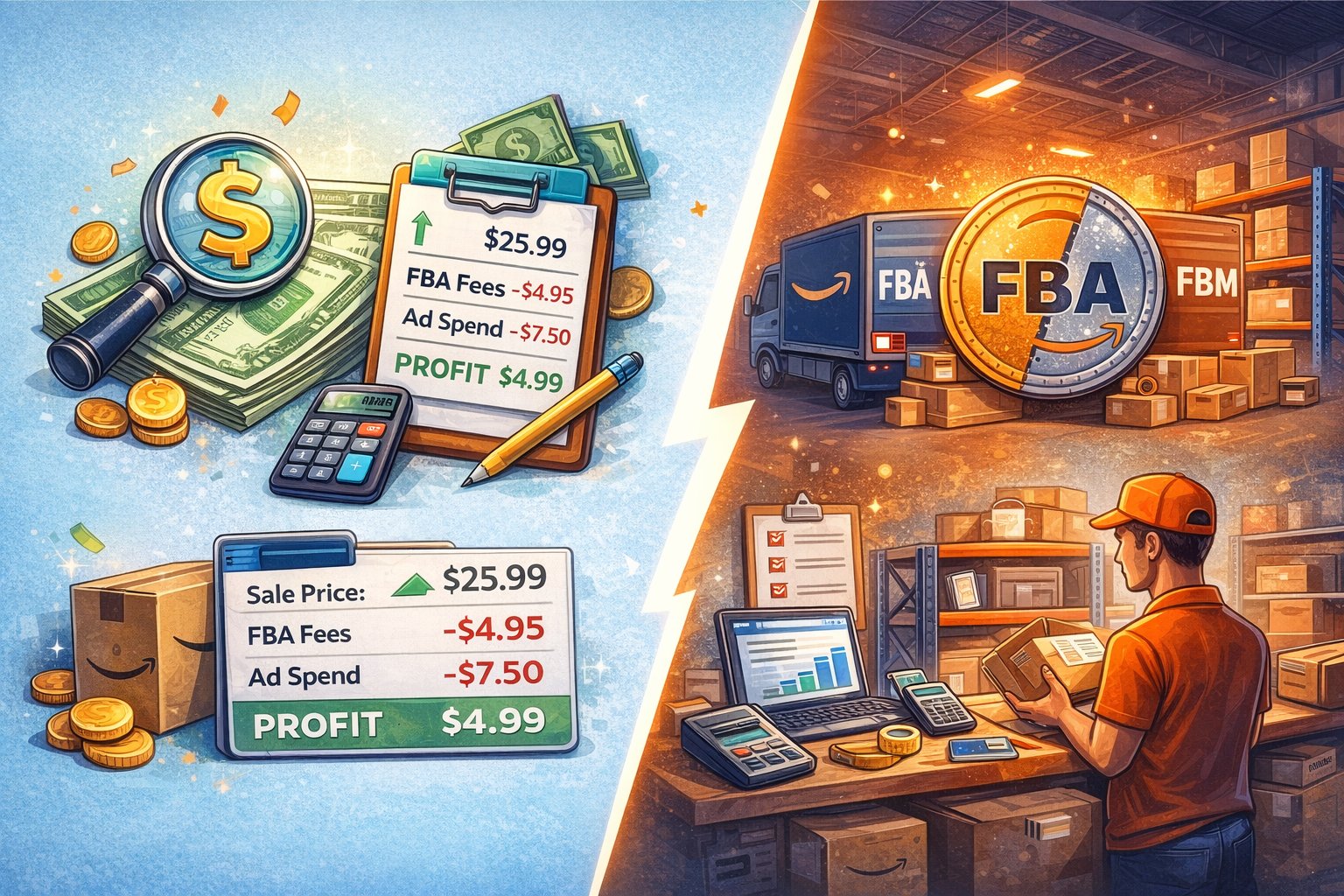
Understanding Amazon FBA and FBM Fees is essential for building a profitable Amazon business. While increasing sales is important, controlling expenses is equally necessary.
Many sellers focus on revenue without considering fulfillment costs, storage fees, advertising, and returns. As a result, their profits may be lower than expected.
This guide explains the main Amazon selling costs and how to choose the right fulfillment strategy.
1. What Are Amazon FBA and FBM Fees?
Amazon offers two main fulfillment options: Fulfillment by Amazon (FBA) and Fulfillment by Merchant (FBM).
With FBA, Amazon stores inventory, prepares orders, and ships products to customers. However, sellers pay fulfillment and storage fees.
In contrast, FBM sellers manage shipping and inventory themselves or through logistics partners.
Both options have advantages. Therefore, sellers should compare their total costs before choosing a fulfillment method.
2. Understanding Amazon Selling Fees
Amazon charges several fees that affect profitability.
The most common expenses include:
- Referral fees: Charges based on the product category and applicable sales price.
- FBA fulfillment fees: Costs for picking, packing, and shipping orders.
- Storage fees: Charges for inventory stored in Amazon fulfillment centers.
- Advertising costs: Expenses from Sponsored Products and other campaigns.
- Additional fees: Applicable return, inventory removal, and other service charges.
Furthermore, sellers should consider product acquisition costs and inbound shipping.
Understanding these expenses helps businesses avoid unexpected losses.
3. Amazon FBA vs FBM: Which Is Better?
Choosing between FBA and FBM depends on product characteristics, sales volume, and operational capabilities.
Advantages of FBA
FBA can simplify fulfillment and provide eligible products with Prime delivery benefits.
Additionally, Amazon handles many order-related activities.
However, storage and fulfillment fees can reduce margins.
Advantages of FBM
FBM provides greater control over inventory and shipping operations.
It may also be suitable for oversized products or businesses with efficient logistics networks.
Nevertheless, sellers must manage delivery performance and customer service.
The best option is the one that delivers reliable service while protecting profitability.
4. How to Calculate Amazon Profitability
Understanding Amazon FBA and FBM Fees is only the beginning. Sellers must also calculate their actual product profitability.
A simplified formula is:
Contribution Profit = Net Revenue − Product Costs − Selling Fees − Fulfillment Costs − Advertising Costs
For example, consider a product sold for $50.
| Expense | Amount |
|---|---|
| Selling price | $50 |
| Product cost | $15 |
| Referral fee | $7.50 |
| Fulfillment cost | $6 |
| Advertising | $5 |
| Other variable costs | $2 |
| Contribution profit | $14.50 |
In this example, the contribution margin is 29%.
However, fixed operating expenses and other applicable costs must also be considered when calculating final net profit.
5. How to Reduce Amazon Selling Costs
Sellers can improve profitability by focusing on operational efficiency.
First, review fulfillment expenses regularly. Compare FBA and FBM costs for individual products.
Next, monitor inventory levels to avoid unnecessary storage charges.
Additionally, optimize advertising campaigns to reduce inefficient spending.
Finally, improve product listings to help shoppers make informed purchasing decisions.
These strategies can support stronger margins without relying exclusively on higher sales volume.
6. Track the Right Amazon Profitability Metrics
A successful Amazon business needs consistent financial monitoring.
Important metrics include:
- Net sales and units sold.
- Product contribution margin.
- Fulfillment and storage costs.
- Advertising Cost of Sales (ACOS).
- Total Advertising Cost of Sales (TACOS).
- Inventory turnover.
- Product return rate.
By reviewing these indicators regularly, sellers can identify costly problems and make better decisions.
Conclusion: Build a More Profitable Amazon Business
Understanding Amazon FBA and FBM Fees helps sellers make smarter operational and financial decisions.
Although both fulfillment models offer benefits, profitability depends on controlling costs and maintaining efficient processes.
Therefore, businesses should regularly review selling fees, advertising expenses, inventory performance, and product margins.
At MadTov Consulting, we help brands optimize Amazon operations, analyze profitability, and develop strategies for sustainable marketplace growth.
Contact MadTov Consulting to improve your Amazon performance and protect your profit margins.